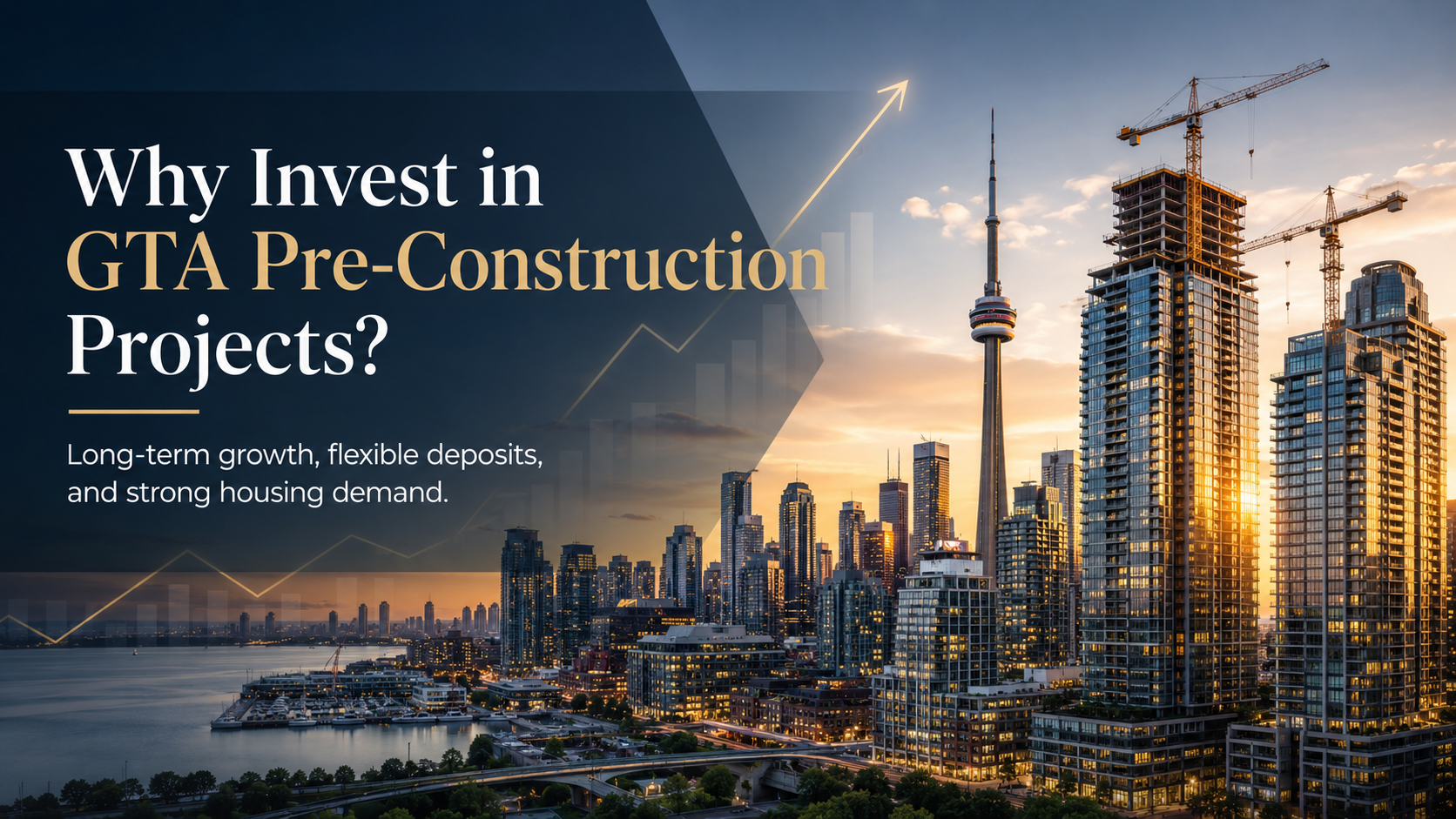
The Greater Toronto Area continues to be one of Canada’s most important real estate markets. With a growing population, expanding transit infrastructure, strong employment centres, and continued demand for housing, the GTA remains an attractive region for buyers looking beyond today’s market and thinking about long-term ownership.
For investors, pre-construction real estate can provide a different strategy than purchasing an existing property. Instead of buying based only on current market conditions, investors have the opportunity to secure a property today that may not be completed for several years.
While every investment carries risk, the right pre-construction project, purchased at the right price and in the right location, can offer several advantages.
1. Enter the Market With a Longer Time Horizon
One of the biggest differences between pre-construction and resale real estate is timing.
When purchasing a resale property, buyers normally need to arrange their mortgage and complete the purchase within a relatively short period.
With pre-construction, the completion date may be several years away. This gives buyers additional time to prepare financially, increase their savings, strengthen their income, and plan for future financing.
For investors who believe in the long-term growth of the GTA, this extended timeline can be especially valuable.
2. Deposits Are Often Paid Over Time
Instead of providing the entire down payment at once, many pre-construction projects use a structured deposit schedule.
Depending on the development, deposits may be divided into several payments over months or even years.
This can make it easier for some investors to build their real estate portfolio without committing the full amount of capital immediately.
The exact deposit structure varies significantly between developments, which is why reviewing the payment schedule before purchasing is essential.
3. Opportunity to Purchase in Developing Communities
Some of the strongest opportunities in real estate emerge before a neighbourhood reaches its full potential.
Across the GTA, new residential communities are being developed around:
- New transit infrastructure
- GO Transit stations
- Major highways
- Employment centres
- Universities and colleges
- Shopping and entertainment districts
- Master-planned communities
- New schools and public amenities
Buying during the earlier stages of a community’s development may allow investors to participate in its long-term transformation.
The key is not simply finding a new building. It is identifying an area where future residents will actually want to live.
4. Population Growth Supports Long-Term Housing Demand
The GTA remains a major destination for professionals, families, students, businesses, and newcomers to Canada.
As the population grows, additional housing is required across Toronto and surrounding municipalities such as Mississauga, Vaughan, Markham, Oakville, Brampton, Pickering, Richmond Hill and other expanding communities.
For investors, population growth matters because sustainable real estate demand ultimately comes from people who need places to live.
Projects located near employment, transportation, education and everyday amenities may be particularly well positioned to attract future buyers and tenants.
5. Brand-New Properties Can Appeal to Future Tenants
Newer condominiums and townhomes can be attractive to tenants because they often offer modern layouts, updated finishes, energy-efficient systems and newer amenities.
Depending on the development, features may include:
- Fitness centres
- Co-working spaces
- Rooftop terraces
- Concierge services
- Smart-home technology
- EV charging
- Parcel delivery rooms
- Entertainment spaces
- Outdoor amenities
A well-designed new development in a desirable location may compete more effectively for tenants than an older property requiring significant upgrades.
6. Lower Maintenance Requirements During the Early Years
Another potential advantage of purchasing a newly built property is that major components are new.
Appliances, plumbing, electrical systems, windows, HVAC equipment and common building systems have not experienced decades of wear.
Although investors should always budget for repairs, condominium fees and unexpected expenses, newer properties may require fewer immediate renovations than older resale properties.
This can be particularly attractive to investors who prefer a more hands-off ownership strategy.
7. Potential for Long-Term Appreciation
Pre-construction investing is generally most effective when approached with a long-term perspective.
An investor may purchase a property several years before completion. During that period, the neighbourhood, local infrastructure and broader housing market can change considerably.
If the market value of comparable properties rises by the time the project is completed, the investor may benefit from appreciation.
However, appreciation should never be assumed.
Real estate markets move in cycles, and purchase price, interest rates, development quality, supply and location all influence future value.
A strong investment should make sense based on fundamentals rather than relying entirely on prices increasing.
8. Access to Early Launch Opportunities and Incentives
Developers sometimes release projects in stages.
Early purchasers may receive access to preferred inventory, floor plans or promotional incentives before a project becomes widely available.
Depending on the development, incentives can include items such as:
- Development charge caps
- Assignment privileges
- Extended deposit structures
- Parking incentives
- Locker incentives
- Décor credits
- Reduced administrative fees
Not every incentive makes a project a good investment, however. The underlying property and purchase price remain more important than promotional bonuses.
9. More Choice of Floor Plans and Units
Buying earlier in a project can provide investors with more selection.
Instead of choosing from the remaining inventory near completion, an early buyer may have access to different:
- Floor plans
- Exposure directions
- Building levels
- Views
- Unit sizes
- Bedroom configurations
- Parking options
This matters because not every unit within the same development will perform equally.
For investment purposes, efficient layouts, practical bedroom sizes, good natural light and appropriate price-per-square-foot can be more important than simply purchasing the largest unit available.
10. The GTA Offers Multiple Investment Markets
Investing in the GTA does not necessarily mean purchasing a downtown Toronto condominium.
Different areas can serve very different investment strategies.
An investor might prioritize:
Toronto: urban lifestyle, transit access, employment and rental demand.
Mississauga: major employment centres, established communities, transit development and proximity to Toronto Pearson International Airport.
Vaughan: expanding transit connectivity and large-scale master-planned communities.
Markham: technology employment, established neighbourhoods and strong residential demand.
Oakville: higher-income demographics, access to Toronto and strong lifestyle appeal.
Durham Region: growing communities where buyers may find different price points compared with central Toronto.
The best market depends on the investor’s budget, timeline and objective.
Location Still Matters More Than the Building
A beautiful sales centre does not automatically mean a strong investment.
Before purchasing a pre-construction property, investors should study the surrounding area.
Important questions include:
- How close is the project to transit?
- Are jobs located nearby?
- What new infrastructure is planned?
- Who is the likely future tenant or buyer?
- What competing developments are being built?
- Are there schools, shops, parks and restaurants nearby?
- Is the unit layout practical?
- What are comparable resale properties selling and renting for?
Understanding these fundamentals can help separate a potentially strong investment from a project that simply has good marketing.
Pre-Construction Is Not Risk-Free
Pre-construction investing also comes with important risks.
Completion dates can change. Mortgage rates may be different when the property closes. Market values can rise or fall. Closing costs may be higher than anticipated, and assignment or rental restrictions can vary from project to project.
Investors should carefully review:
- Purchase price
- Deposit requirements
- Estimated closing costs
- Development charges
- Maintenance fees
- Property taxes
- Expected rental income
- Financing requirements
- Assignment rules
- Occupancy provisions
- HST implications
- Developer reputation
A lawyer experienced with pre-construction agreements should review the Agreement of Purchase and Sale and explain the buyer’s obligations.
Who Should Consider Pre-Construction?
Pre-construction may be worth considering for buyers who have a longer investment horizon and enough financial flexibility to manage deposits, closing costs and future mortgage qualification.
It may be suitable for:
- Long-term real estate investors
- First-time buyers planning several years ahead
- Parents purchasing for children
- Investors building a rental portfolio
- Buyers planning to downsize in the future
- Investors seeking exposure to growing GTA communities
It is generally less appropriate for someone who needs immediate rental income or who cannot comfortably handle changes in financing or closing timelines.
The Investment Is Made When You Buy
In real estate, choosing the right project is only part of the equation.
The price you pay, the unit you select and the location you choose can determine much of the investment’s future performance.
Two investors purchasing in the same building can achieve very different results depending on their floor plan, purchase price, exposure and overall strategy.
That is why pre-construction investing should start with numbers and research, not simply with renderings and promotional incentives.
Thinking About Investing in GTA Pre-Construction?
There are hundreds of developments across the GTA, but not every project represents the same opportunity.
Before purchasing, compare projects based on location, developer history, deposit structure, incentives, floor plans, expected carrying costs and the long-term demand for that neighbourhood.
The goal should not be simply to buy pre-construction.
The goal is to identify a property that fits your budget, timeline and long-term investment strategy.
Looking for upcoming pre-construction opportunities in Toronto and the GTA? Contact our team to receive current projects, floor plans, pricing, deposit structures and available incentives.